IEEE TVCG 2026
Neural Cone Radiosity for Interactive Global Illumination with Glossy Materials
Jierui Ren: College of Future Technology, Peking University.
Haojie Jin, Bo Pang, Yisong Chen, Guoping Wang, Sheng Li: School of
Computer Science, Peking University.
Guoping Wang and Sheng Li are also with the National Key Laboratory of
Intelligent Parallel Technology.
*Corresponding author.
IEEE Transactions on Visualization and Computer Graphics, 2026
Video
Abstract
Modeling of high-frequency outgoing radiance distributions has long been a key challenge in rendering, particularly for glossy materials. Such distributions concentrate radiative energy within a narrow lobe and are highly sensitive to changes in view direction. However, existing neural radiosity methods, which primarily rely on positional feature encoding, exhibit notable limitations in capturing these high-frequency, strongly view-dependent radiance distributions.
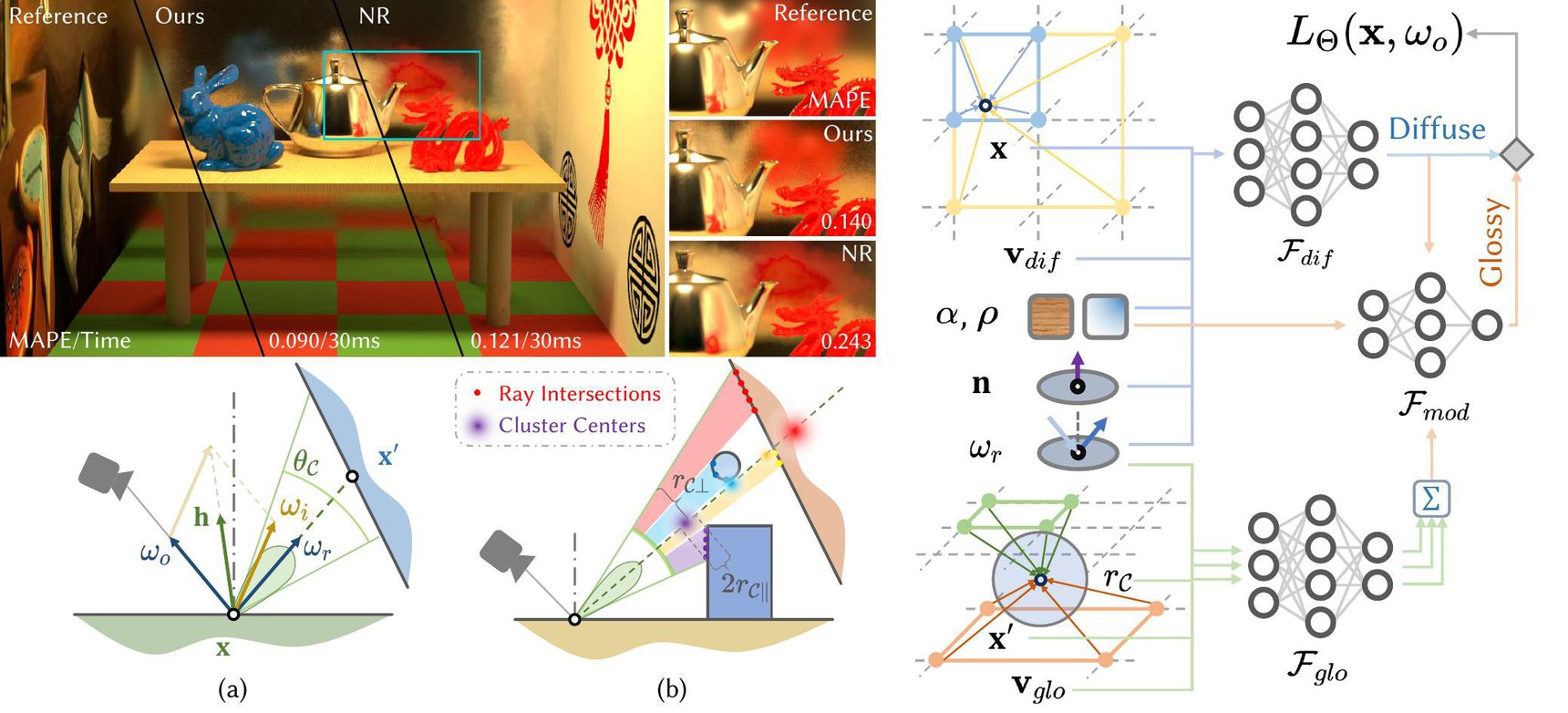
To address this, we propose a highly-efficient approach by reflectance-aware ray cone encoding based on the neural radiosity framework, named neural cone radiosity. The core idea is to employ a pre-filtered multi-resolution hash grid to accurately approximate the glossy BSDF lobe, embedding view-dependent reflectance characteristics directly into the encoding process through continuous spatial aggregation. Our design not only significantly improves the network's ability to model high-frequency reflection distributions but also effectively handles surfaces with a wide range of glossiness levels, from highly glossy to low-gloss finishes. Meanwhile, our method reduces the network's burden in fitting complex radiance distributions, allowing the overall architecture to remain compact and efficient.
Comprehensive experimental results demonstrate that our method consistently produces high-quality, visually clean renderings in real time under various glossiness conditions, and delivers superior fidelity and realism compared to baseline approaches.
Method
- We propose a pre-filtered radiance model that extends neural radiosity to handle glossy materials efficiently.
- We introduce a clustering-based approximation for integrating reflected contributions across glossy BSDF lobe.
- We present a network architecture that integrates both primary surface interactions and the projected contributions of glossy reflections.
Training, interactive viewing, and offline rendering are released with a customized Mitsuba 3.5.2 backend.
Citation
@article{ren2026ncr,
  title   = {Neural Cone Radiosity for Interactive Global Illumination with Glossy Materials},
  author  = {Ren, Jierui and Jin, Haojie and Pang, Bo and Chen, Yisong and Wang, Guoping and Li, Sheng},
  journal = {IEEE Transactions on Visualization and Computer Graphics},
  year    = {2026},
  eprint  = {2509.07522},
  archiveprefix = {arXiv}
}